AI in accounting: what it can handle and what stays with the accountant
AI in accounting prepares the groundwork: it extracts data from documents, matches payments and sorts clients' mail. Tax judgement and responsibility stay with the accountant.


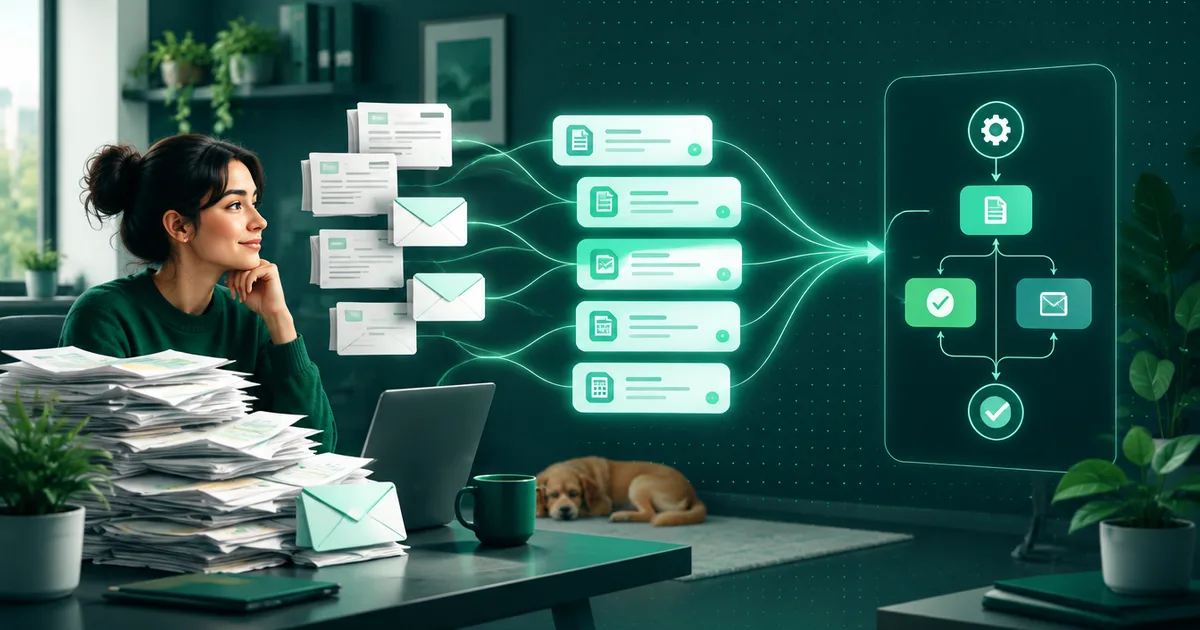
AI in accounting makes sense today for work that repeats and follows the same rules: reading a document, extracting data from it, matching a payment to an invoice, sorting mail. The decision on how to post a disputed case and the responsibility for the accuracy of the accounts stay with a person. Below is a breakdown of what can be automated and where automation stops.
Extracting data from invoices and documents
The biggest time sink in an accounting firm is usually retyping. Invoices and receipts arrive as PDFs, scans and photos, and someone has to get the supplier, amount, date, variable symbol and line items from them into the accounting software. Automation reads the document (even a scanned one), extracts the data and prepares a draft entry. The technical process step by step is described in the article How automated invoice processing works.
What matters is what happens next. A document that does not match the order or is missing a detail is not entered by the system on its own. It prepares it and sends it for review instead of guessing. Our Invoice and document processing service costs from €990 excl. VAT and deployment takes 1 to 4 weeks, depending on the number of invoice formats and integrations. For a company with a few invoices a month it will not pay off; in that case it is quicker to retype them by hand.
Matching payments and sorting documents
Another repetitive task is matching payments from the bank statement with issued invoices. The same applies as with documents: clear matches are paired automatically, unclear ones (partial payment, missing variable symbol) go to a person with an explanation of what does not match.
In a similar way, clients’ documents can be sorted by type, cost centre and month, or material can be gathered before the monthly or annual closing.
Sorting e-mails and questions from clients
An accounting firm receives many messages every day: new enquiries, requests to change details, requests for statements, questions about processing status. Automation sorts them and routes them to the right colleague; an AI assistant can answer a routine question about processing status or a deadline and passes a more complex matter to the accountant. This is what our AI for accounting service for accounting firms covers.
System integration
Extracting data is only half the work. So that data does not have to be exported and imported by hand, the bank statement, client portal and accounting software need to be connected. System integration with us starts from €1,900. Without it, AI remains an island from which someone still copies results into another program.
What stays with the accountant when using AI in accounting?
With AI in accounting, tax judgement, reviewing and confirming every entry, and handling exceptions such as an unusual supplier or a document without a mandatory detail stay with the accountant. Automation reduces the manual work of preparing material; the accounting firm remains responsible for legal compliance as before.
- Tax judgement. AI does not give tax advice and does not vouch for legal compliance. Professional advice to the client comes from the accountant.
- Entry and responsibility. A draft entry from a document is always reviewed and confirmed by a person. Nothing is posted automatically without this review.
- Exceptions. An unusual supplier, an amount outside the normal range, a document without a mandatory detail. These are exactly the cases that require experience, which is why the system hands them over to a person.
Security of clients’ data
An accounting firm works with sensitive documents of other companies, so you need to know in advance which documents the system sees, where they are stored and who has access to them. We write about this in more detail in the article AI in your company, safely: where your data ends up.
What will e-invoicing change in accounting?
E-invoicing will change the input in accounting: with a structured invoice in XML format, reading the image is no longer needed; review, matching and entry remain. As long as some suppliers send PDFs and photos, reading documents through automation remains necessary. The timeline of the Finančná správa SR (the Slovak Financial Administration) lists 1 January 2027 as the date the e-invoicing legislation takes effect.
On its page eFaktúra (eInvoicing), the Financial Administration states that receiving electronic invoices will be mandatory for all legal entities and businesses that are taxable persons under Slovak law, including sole traders, the liberal professions and landlords. Its timeline lists 1 January 2027 as the date the e-invoicing legislation takes effect. According to the Financial Administration, an electronic invoice is not an ordinary PDF but a structured file in XML format, intended for automated processing.
Where to start
We recommend starting with a process analysis (from €490, 3 days to a week): we find out which types of documents you process most often and where automation will have the biggest impact. This is followed by a pilot on one document type with measurement of processing time and error rate. If you would like to know what this would mean for your firm, write to us via the contact form.