Artificial intelligence for business: what to actually use it for
Artificial intelligence makes sense in a company where the same work with clear rules repeats every day: invoices, orders, customer questions and moving data between systems. It isn't suited to decisions about people or legal judgment.


Artificial intelligence pays off in a company where people do the same work every day according to rules that can be described: they retype data, sort messages, answer the same questions. It isn’t suited to decisions that require judgment, accountability or data that doesn’t exist. This article goes through specific uses, then industries, and finally what to watch out for.
What can artificial intelligence be used for in a company?
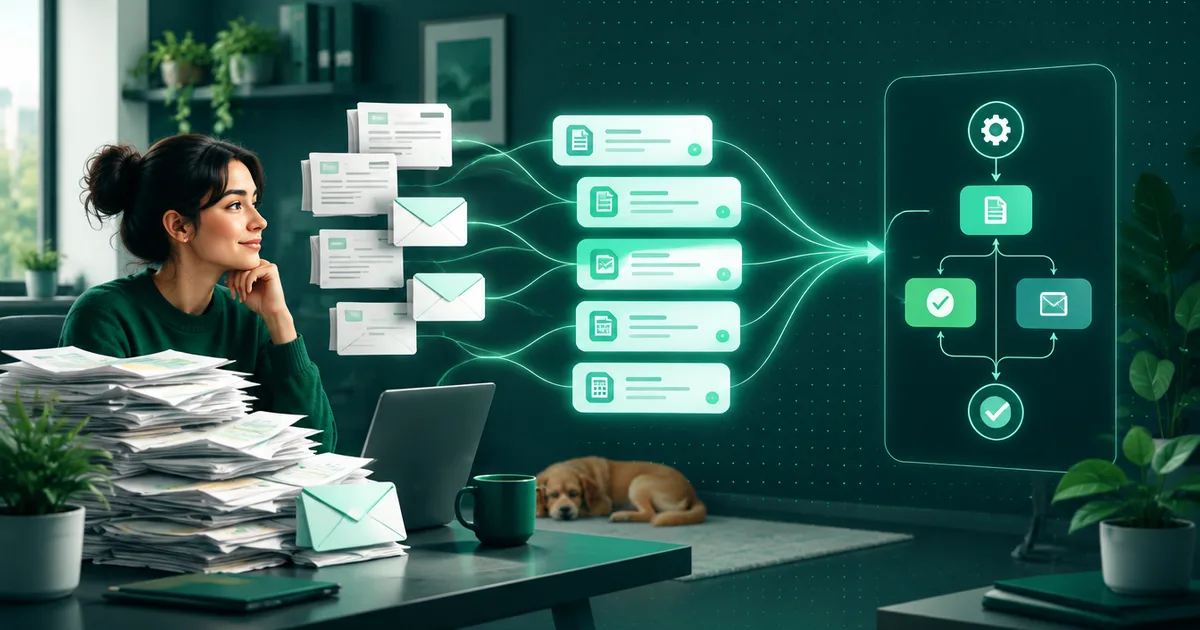
In companies, artificial intelligence is most often used for four things: processing invoices and documents, processing orders and inquiries from email, answering customers’ recurring questions, and connecting systems so that they then send data to each other on their own. These uses recur because there are clear rules and measurable work behind them.
Invoices and documents. The automation reads an incoming invoice, extracts the supplier, amount, date and items, compares them with the order and writes them into the accounting or ERP system. An invoice that doesn’t match is sent to a person. This is described in detail in the article How automated invoice processing works and the Automated invoice and document processing service (from €990).
Orders and inquiries from email. An order arrives as free text or an attachment, and someone retypes it into the system. AI extracts the items, quantities and contact details, checks them against the price list or stock, and sends unclear cases back to be completed. More in the Automated order and inquiry processing service (from €1,490).
Customer service. An AI assistant (from €900) answers recurring questions, for example about order status, delivery or opening hours. Complaints, grievances and questions it has no certain answer to are passed on to a person, together with the context.
Connecting systems. If an order is created in the e-shop, invoiced somewhere else and stock is kept in a third system, someone reconciles the data by hand. System integration (from €1,900) makes sure the systems send data to each other on their own. For a simple flow, n8n or Make is enough; for more complex logic, an API integration is written. A comparison of the tools is in the article n8n, Make or Zapier.
All four are part of the AI automation for businesses service. The approach is the same: first a process analysis (from €490), then a pilot on one process (from €2,900), and only once it works, deployment and expansion.
How do you choose the first process to automate?
Choose the first process to automate by three traits: it repeats, it can be described with rules, and it takes time, not judgment. If one person can’t explain it to another in a few minutes, it’s a poor candidate for now. If you can describe it step by step without “it depends”, it’s a good candidate for a pilot.
How to choose is described in the article How to choose the first process to automate in a company.
If you’re interested in the difference between a simple rule-based robot and AI that can cope with inconsistent input, see AI automation vs. RPA. And if you’re wondering how an agent differs from a chatbot, the answer is in the article What is an AI agent.
Industries: where the work is similar
Most companies will recognise themselves in the same four uses, just with a different emphasis. This is what recurs most often by industry.
- E-shops. Orders from various channels, supplier invoices and questions about order status.
- Wholesale. Customer orders, invoices and stock across branches.
- Manufacturing. Orders, invoices for materials and inquiries about dates and capacity.
- Accounting. Documents from clients prepared for review.
- Marketing agencies. Client inquiries, invoices and moving data between tools.
- HR and recruitment. Administration around recruitment and candidates’ questions.
- Logistics and transport. Transport orders, carriers’ invoices and inquiries about shipment status.
- Construction. Inquiries from investors, invoices from subcontractors and for materials.
- Real estate. Inquiries from property portals and email, recurring questions from prospective buyers and tenants.
- Law firms. Sorting client inquiries, invoices and transferring data between systems.
- Hotels and accommodation. Guest inquiries, common questions and supplier invoices.
- Municipalities and towns. The registry office (incoming mail), invoices and citizens’ questions.
What is artificial intelligence not suited for in a company?
In a company, artificial intelligence isn’t suited to decisions about people, to legal and tax judgment, or to processes that lack clear rules or data. It can prepare the groundwork: classify a document, extract data from it and flag a discrepancy. The decision, the exceptions and the uncertain cases stay with the person who is accountable for them.
This is the part salespeople like to skip.
- Decisions about people. Who gets the job, which employee gets a promotion, whose application is rejected. AI can prepare the groundwork and answer candidates’ routine questions, but the decision belongs to the person who is accountable for it.
- Legal and tax judgment. AI can classify a document, extract data from it and flag a discrepancy. Assessing how a specific case should be resolved legally or for tax purposes is a job for an expert.
- Processes without clear rules. If the same situation is decided one way one time and another way the next, depending on mood or personal experience, there’s nothing to automate. The rules need agreeing first.
- Processes without data. Without source material to draw on, an assistant makes answers up. Good output needs good input.
That’s why every solution we build leaves exceptions and uncertain cases to a person. The machine prepares the record; the decision on an exception stays with people.
Data and cost
Before deployment, it’s worth knowing which data goes into the tool, where it is processed and who has access to it. This is covered in the article AI in the company, safely: where your data ends up. On money and return, see How much an AI agent costs in a company, and when it pays off.
Where to start
Pick one process that repeats and takes time, and describe it step by step. If you manage it without “it depends”, it’s a good candidate for a pilot. If not, start with a process analysis: we’ll look at where automation has the best ratio of benefit to risk. Write to us using the form on the AI automation for businesses page.